
How Re-Refined Base Oils Drive a Cleaner Energy Future

Every year, millions of tonnes of used lubricating oil are drained from engines, gearboxes, and turbines worldwide. Much of it is still burned or discarded — wasting a valuable resource. Re-refining technology is changing that narrative.
By recovering used oils and processing them into high-quality base stocks, re-refining supports both environmental stewardship and economic value creation. For Synergy Sol Trading, this transformation represents the future of smarter, circular energy systems: less waste, lower emissions, and stronger market resilience.
Despite decades of recycling progress, less than half of the world’s used oil is properly collected for treatment, according to the International Energy Agency (IEA). The rest is either illegally dumped or burned as low-grade fuel, releasing toxins and greenhouse gases.
Re-refining offers a scalable, industrial solution: used oil is dehydrated, filtered, and hydrotreated to remove contaminants and restore chemical integrity. The result — API Group II or III base oils with performance equivalent to virgin stocks.

Re-refining uses up to 50–80% less energy and emits 40–50% less CO₂ than producing base oil from crude refining. The process also prevents hazardous oil waste from contaminating soil and groundwater.
Compared to burning used oil as fuel, re-refining reduces particulate emissions by a factor of four and acidifying substances by a factor of five. This measurable impact makes re-refined base oils a powerful enabler of corporate ESG targets.
Beyond the environmental upside, re-refining delivers solid business logic. Feedstock (used oil) is cheaper and more localized than crude, insulating producers and traders from global price volatility.
Operating costs are lower, energy use is reduced, and the output — premium base oils — can command competitive margins. As sustainability-linked procurement expands, clients increasingly pay a premium for lower-carbon, traceable base stocks.
According to industry data, modern re-refineries can maintain positive margins even in challenging market conditions, thanks to significantly lower energy consumption and optimized processing efficiencies compared with conventional crude-derived base oils.
A decade ago, re-refined oils were seen as inferior. Today, that perception is obsolete. Advanced hydrotreating and vacuum distillation produce base oils virtually indistinguishable from virgin Group II or III.
Re-refined base oils have come a long way from earlier perceptions. With today’s advanced hydrotreating and purification technologies, modern re-refined oils consistently achieve performance characteristics comparable to high-quality virgin base stocks. Their stability, viscosity control, and reliability now meet the standards required by lubricant formulators and manufacturers. As a result, re-refined base oils are increasingly accepted across automotive, industrial, and commercial applications — demonstrating that sustainability and performance can now move forward together.
Re-refining embodies the circular economy in the lubricant sector:
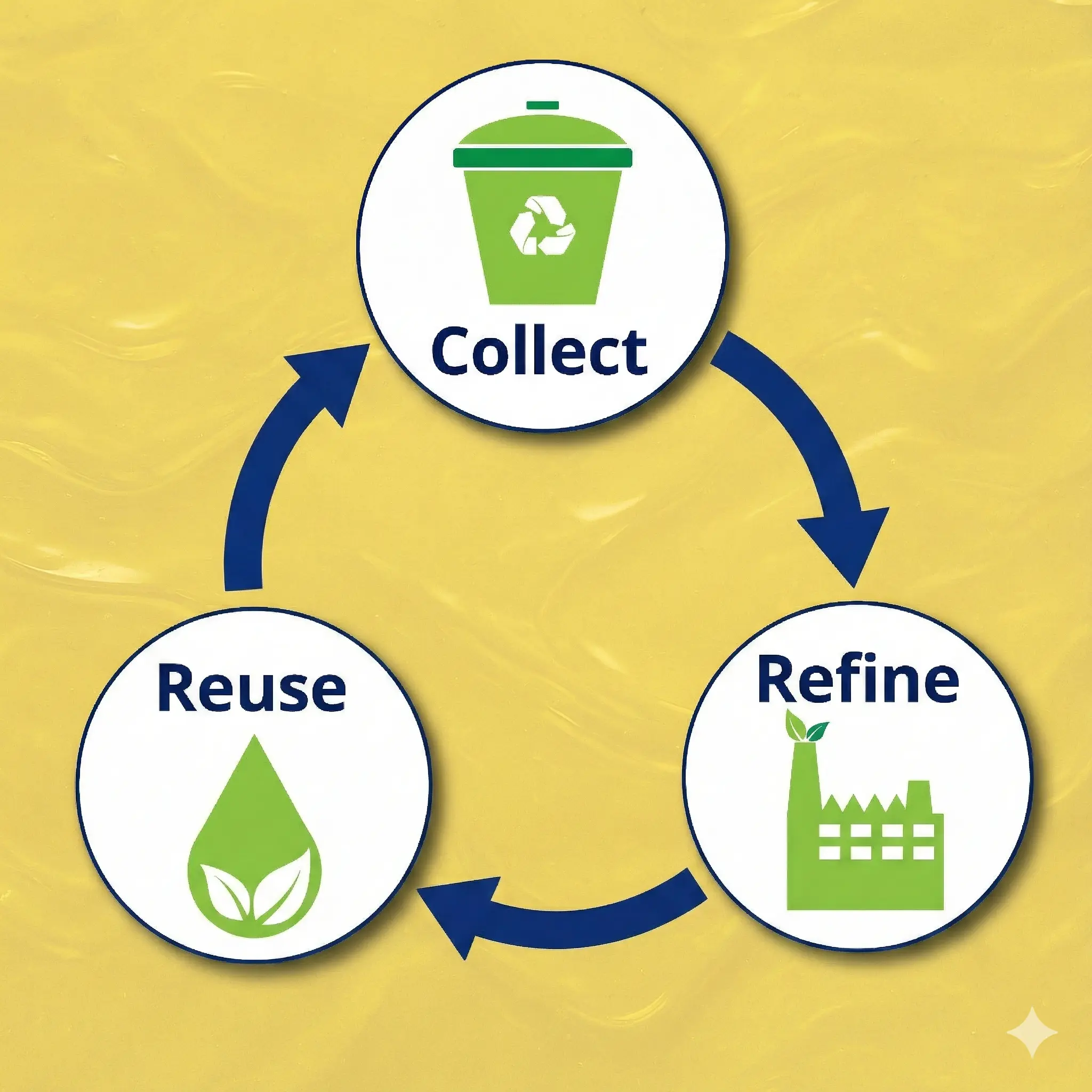
This loop minimizes virgin resource extraction while keeping existing materials in productive use. Each litre of re-refined base oil displaces roughly one litre of crude-derived oil, creating tangible lifecycle carbon savings.
Many governments and corporations now classify re-refined base oils as preferred sustainable materials under their circularity frameworks. The European Commission’s Green Deal and similar policies in the Gulf and Asia are accelerating investment in such projects.
The global re-refined base oil market was valued near USD 6.4 billion (2021) and is projected to exceed USD 9 billion by 2030 (Data Insights Market, 2024). Asia and the Middle East show the fastest expansion as infrastructure, industrial demand, and ESG regulations rise in parallel.
In the Gulf region, re-refining also aligns with national sustainability programs — enabling oil economies to diversify into cleaner downstream industries.

Forward-looking traders, refiners, and lubricant manufacturers can capture value by embedding re-refining in their strategy.
Future-proof checklist:
While the benefits are clear, scaling re-refining requires:
Policies that mandate used-oil recovery or recycled content — such as EU Waste Framework Directive updates — are helping to overcome these barriers.
Re-refined base oils prove that sustainability and profitability can coexist. They conserve natural resources, reduce emissions, and stabilize supply — all while delivering the technical performance the modern world demands.
Re-refining is more than a market opportunity; it is a strategic commitment to future-ready energy.