
How to Read a Base Oil COA (And Why the TDS Won't Save You)

Most quality problems at the plant don't start on the production line. They start earlier, when someone accepts a generic TDS in place of an actual test result and assumes the two documents mean the same thing. They don't, and the gap between them is exactly where a bad lot slips through.
Once you know what you're looking at, reading a base oil certificate of analysis is far simpler than the lab paperwork makes it seem. A COA describes one batch and nothing more: a lot number, a date, the test methods used, and the numbers those methods actually produced. It is not a typical-spec sheet, and it is not a safety leaflet dressed up to look like one. If the page in front of you shows a grade name and a spec range but no measured result next to it, you're not looking at a certificate of analysis. You're looking at a brochure with a lab logo on it. The only way to know what you're really buying is to compare the numbers on the page against your own spec, and then against the last two lots that came off the same still.
Part of the confusion comes from how similar these documents look at a glance, so it helps to lay out what each one actually does and doesn't tell you.
These four documents sit alongside the Incoterms on your trading terms page, and they answer different questions entirely. Deciding how to buy a light Group I cut, packing included, is a sourcing decision you'd make separately for something like SN150. This guide is only about the test sheet, and specifically about learning to tell a real one from a decorative one.
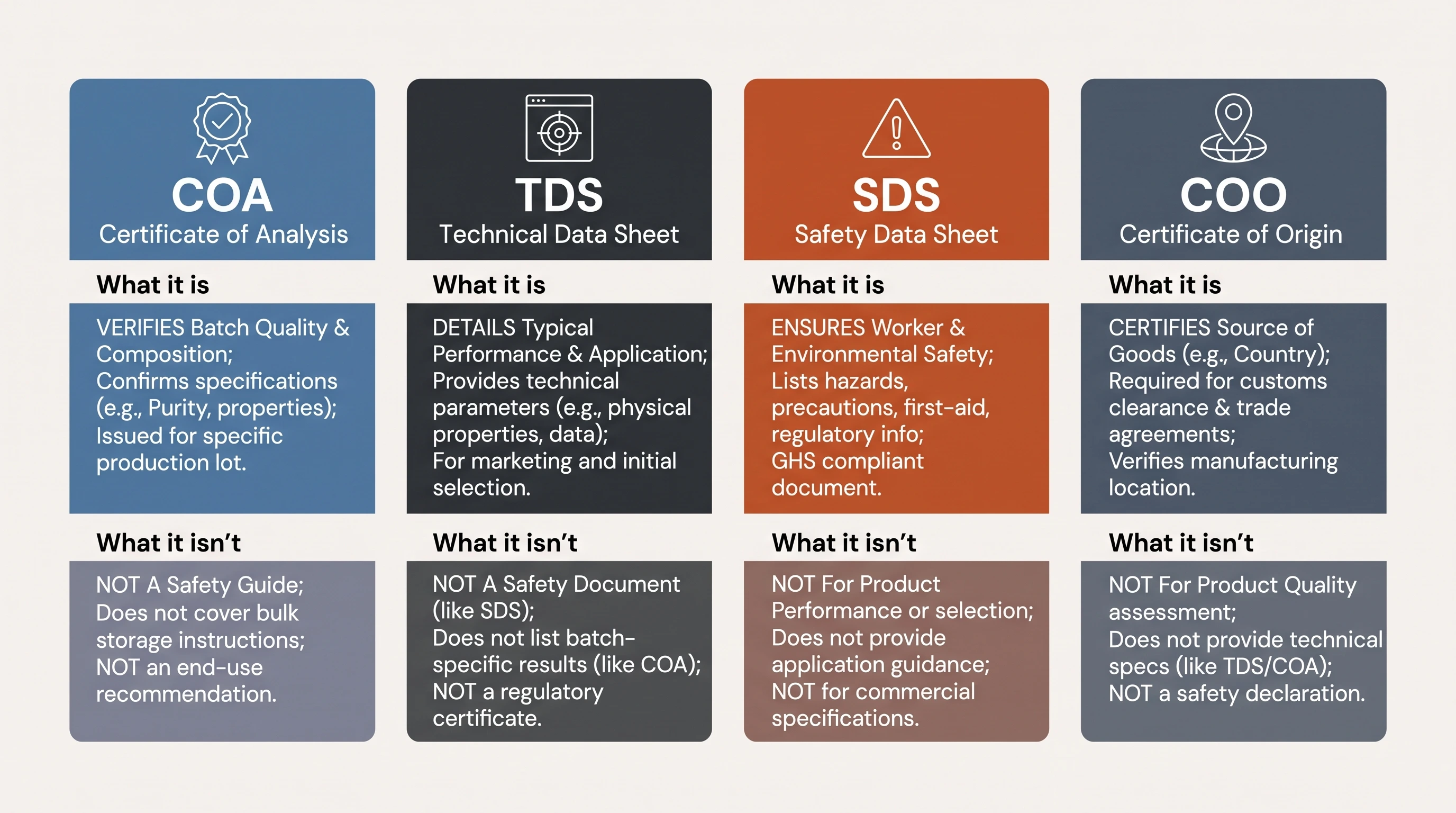
Before you even get to the test results, run through a short checklist on the header of the document itself. You want to see a lot or batch number, a production or analysis date that isn't two years old, a product name that actually matches your RFQ, the name of the lab that ran the tests, and the methods used to run them. If any one of these is missing, there's no point reading further. Stop there and ask for a real sheet.
Once the header checks out, the real work is in the test results themselves. Each line on a COA tells you something specific, and each has a point past which you should walk away from the lot.
One detail that trips up a surprising number of buyers is units. Viscosity should be reported in mm²/s or cSt, and sulphur in mass percent or ppm. Mixing units across lots when you're comparing them side by side is an easy way to misread a perfectly good sheet, or miss a bad one.
Everything about a base oil's identity comes down to two kinematic viscosity readings. The 40°C figure is the practical, everyday handle on the oil, the one that tells you how it behaves in a tank or a pump. The 100°C figure is the one that matters once the oil is actually working inside a hot engine. As a rough guide, SN150 typically comes in near 5 cSt at 100°C, SN500 sits closer to 11, and bright stock is up around 30. If a certificate claims SN500 but the KV100 result reads 5, somebody has mislabelled a light cut as a heavy one. The reverse is just as common: an SN150 claim with a KV40 of 95 is really a heavy oil wearing the wrong name.
Viscosity index is simply what you get when you run those two KV numbers through a standard calculation (D2270). It isn't a third, independent viscosity measurement; it's a way of expressing how stable the oil stays as temperature swings. A VI somewhere between 80 and 120 places the oil in the Group I/II range. Anything at 120 or above starts to look like Group III, but only if the saturates and sulphur numbers back that up. A high VI sitting next to high sulphur isn't evidence of a Group III oil. It's evidence of a claim that doesn't hold together.
It's worth saying plainly: API groups are defined by three specific numbers, not by whatever name is printed on the drum. An oil needs saturates at 90 percent or above and sulphur at 0.03 percent or below before it can even be considered Group II or III territory. From there, viscosity index is what separates the two: under 120 lands you in Group II, and 120 or higher moves you into Group III. Any time a supplier is marketing an oil as premium, this is the threshold to check for yourself. It's also worth remembering that Group I isn't automatically inferior. It can fail either the saturates or the sulphur test and still be a perfectly usable industrial stock. What it genuinely cannot do, no matter how good it looks otherwise, is carry a Group II label it hasn't earned.
Re-refined base oil gets tested against the same standards. ATIEL's 2025 code allows it to be treated like virgin stock for grouping purposes, but only if the producer can hold those numbers steady even as the feedstock going into the process changes. A single attractive COA doesn't demonstrate that kind of consistency. Only a pattern across multiple lots does.
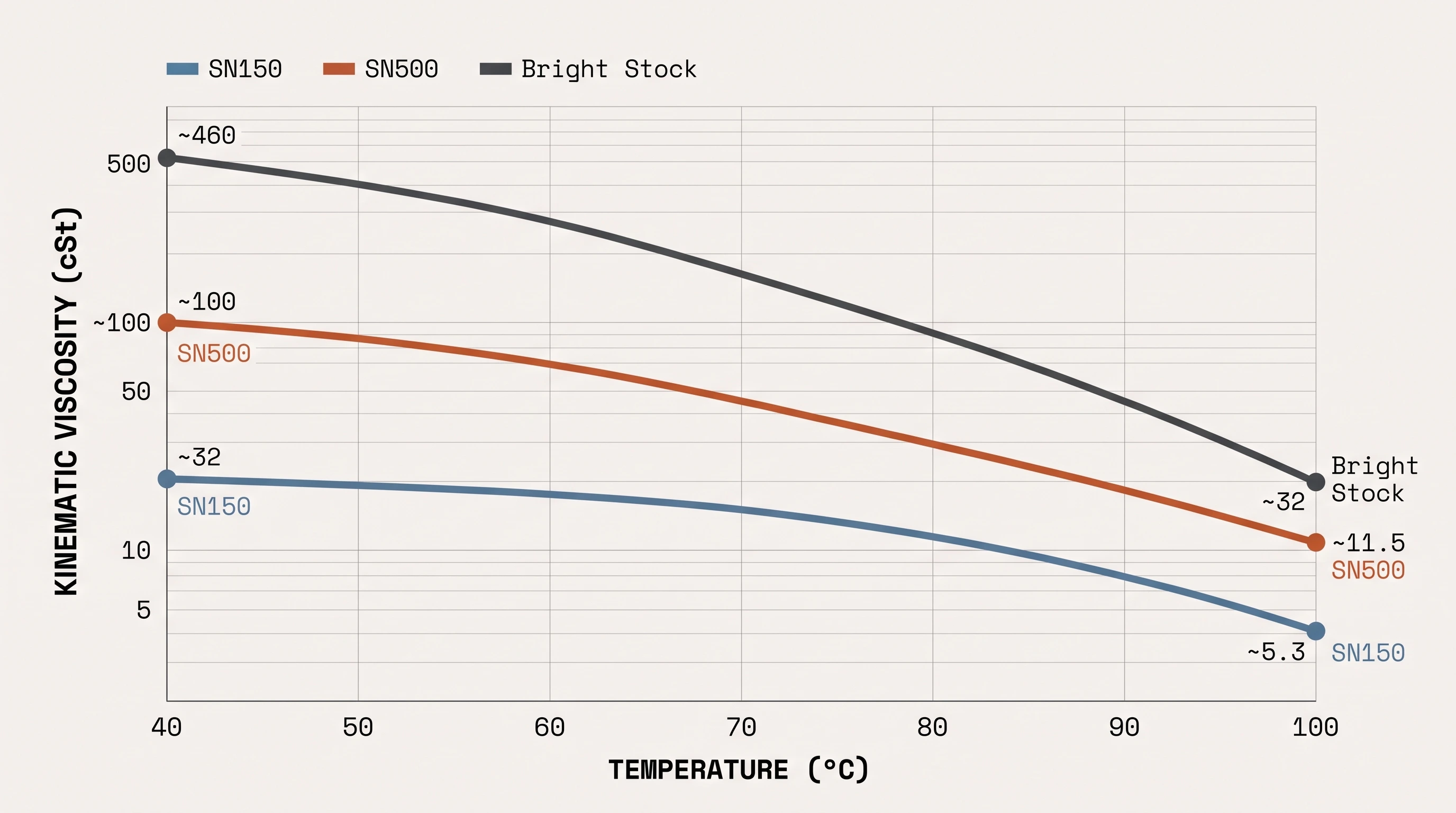
Chart comparing viscosity-temperature curves for SN150, SN500 and bright stock base oils
A weak flash point (measured by Cleveland Open Cup, D92) is usually a sign that gasoline or diesel is still sitting in the cut. So when you see a "light SN150" with a soft flash reading, what you're often looking at isn't a genuinely light oil, it's a contaminated one. Pour point (D97) marks the temperature where the oil simply stops flowing, which still matters a great deal to anyone storing drums through a Gulf winter. If a grade that used to sit at −9°C suddenly shows a pour point of −3°C, that's not seasonal noise. That's a different dewaxing process, and it's worth asking why.
Colour (D1500) works as a rough finish check rather than a hard quality metric. A pale result is expected on SN150, and a darker one is entirely normal on SN500 or bright stock. What should raise a flag is colour that keeps getting darker lot after lot, since that usually points to oxidation or a still that needs cleaning. Density (D4052), meanwhile, only confirms that the sample belongs in the mineral-oil family. It says nothing about whether the lot passes on quality, and it should never be presented as if it does.
Noack testing (D5800) earns its place whenever a blender is working toward a PCMO or a 0W formulation, where evaporation loss actually matters to the finished product. Running it on a bright-stock grease fill wastes the test entirely. Running it on a Group III 4 cSt oil, on the other hand, makes it arguably the most important line on the whole sheet.
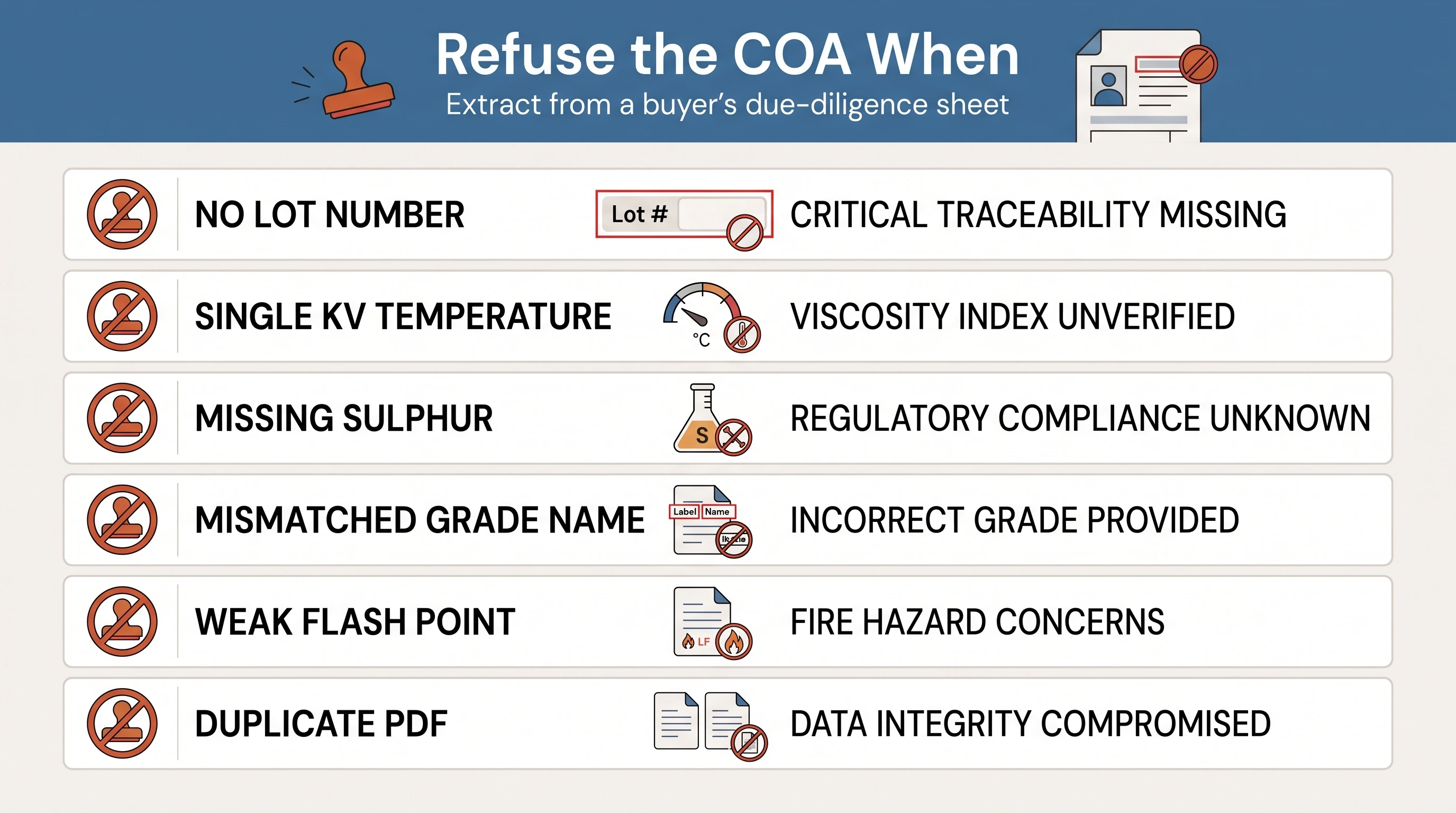
Some issues are serious enough that there's no point negotiating around them. Walk away from a COA if you see any of the following:
A single clean-looking COA proves very little on its own. Ask for three recent ones instead: one good sheet could be a sample chosen carefully to impress you, but three consistent results in the same band tell you something real about the supplier. On a first lift, or on any large cargo, it's worth adding independent inspection through SGS or Bureau Veritas as well. When the plant's own sheet and the inspector's sheet agree, you can move forward with confidence. When they don't, trust the inspector.
To avoid this problem altogether, build the requirements into the request for quotation itself:
Apply the same level of scrutiny here that you would to any other base oil purchase. If a supplier can't produce this paperwork on request, that alone tells you most of what you need to know about the lot.
What is a base oil COA?
It's a certificate of analysis covering one specific lot: measured results, the methods used to get them, and a date. It is not a typical-spec TDS, and it is not a safety data sheet.
What is the difference between a COA and a TDS?
The TDS describes the target range the grade is supposed to fall within. The COA shows what this particular batch actually tested at. When you're deciding whether to buy, the COA is the document that matters.
Which COA lines matter most?
KV at 40°C and 100°C, viscosity index, sulphur, saturates, flash point, pour point, and colour. Add Noack to that list if the oil is going into a PCMO blend.
Can I accept a COA that only shows ranges instead of results?
No. A range with no measured value next to it is closer to a brochure than a certificate. Always ask for the actual figure and the method used to obtain it.
How many COAs should I compare before committing to a supplier?
Three recent lots is the standard. One good sheet might just be a carefully chosen sample; three consistent results tell you the supplier can actually repeat their numbers.
Does a COA replace third-party inspection?
No. On a first shipment, or on any large cargo, bring in an independent inspector like SGS or Bureau Veritas. Their sheet and the plant's sheet should match.
Synergysol Trading supplies Group I, II, and III base oils to blenders across the Middle East, Africa, and Europe, and every quote comes with a lot-specific COA, transparent packing terms, and a named Incoterm attached. If you're evaluating a supplier, ask for the current sheet, not a typical one. Contact Synergysol Trading for current availability, a sample COA, or lead times.