
ICIS Middle East Base Oils Conference 2026: What It Means for Blenders and Buyers

Freight routes close, sanctions shift, and a base oil price you could plan around last quarter no longer holds. If you blend lubricants or distribute base oils, you feel this in delayed cargoes, changing offers, and additive shortages that stall a production run.
That is the backdrop for the 21st ICIS Middle Eastern Base Oils and Lubricants Conference, held at Park Hyatt Dubai on 5 and 6 October 2026. A separate base oils course follows on 7 and 8 October at the same hotel and is ticketed on its own. This guide explains what is on the agenda, the terms behind it, and what it means for buyers sourcing from the region.
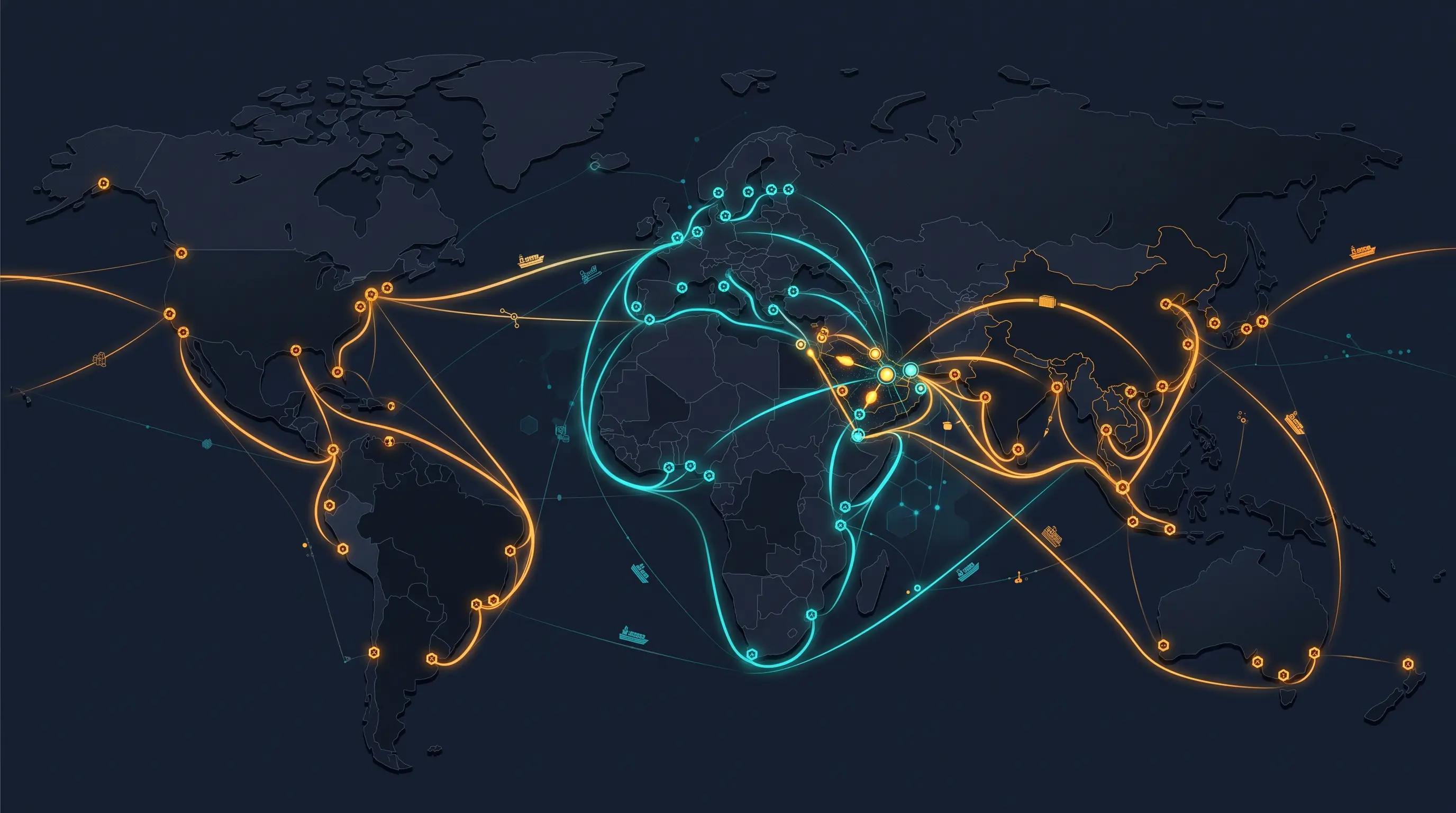
The Middle East is a major supply point for base oils, and the Gulf sits on routes that serve several markets at once.
East Africa. Blenders and distributors in Ethiopia, Kenya, and Tanzania depend on imported base oil, so their lead times and landed costs follow what happens on Gulf and Red Sea routes. A disruption there reaches a Nairobi or Dar es Salaam blender quickly.
Sudan. Imports into Port Sudan depend on shipping lanes and paperwork that can change at short notice, which makes supplier reliability and documentation as important as price.
Europe. European buyers draw on many sources, but when supply tightens elsewhere, Middle Eastern cargoes become part of how they cover gaps.
The common thread is that a buyer far from the Gulf is still exposed to what happens inside it. That is why a conference built around "Navigate the Storm," "Resilience Redefined," and "The Future is Now" is worth following even if you are not in Dubai.
Not all base oils respond to disruption the same way, because they come from different processes and serve different demand.
Group I is solvent refined and tends to serve industrial oils and some engine oil grades. Groups II and III are hydroprocessed and feed modern engine oils with tighter performance requirements. When a route closes or a plant has an outage, buyers rarely lose one group in isolation. They lose the ability to switch easily between grades, and that is where formulations get tested.
For a blender, the practical effects are:
Ask your supplier which grades they can source from more than one origin. That answer tells you more about resilience than a spot price does.
The American Petroleum Institute sorts base oils into groups by saturates, sulfur content, and viscosity index (VI), which measures how stable viscosity stays as temperature changes.
Groups IV (PAO synthetics) and V (everything else, including esters) sit outside these three. Higher groups generally mean better oxidation stability and performance in modern engine oils, which is why engine oil quality pulls on the whole base oil business, a point the ICIS course covers.
Base oil is only part of a finished lubricant. Additive packages, which supply detergents, dispersants, and anti-wear protection, are the other part. Localisation means producing or stocking additives closer to the blender, so that freight delays or trade restrictions do not stop a blending run. The Lubrizol Additives session on Tuesday addresses exactly this risk.
Electric vehicles do not use engine oil, but they do use specialised fluids, and the global fleet is still dominated by combustion engines. The question for the industry is how fast demand for engine oil base stocks changes in different regions, and where new demand grows. Kline & Company covers what e-mobility means for lubricants in the Middle East on day two.
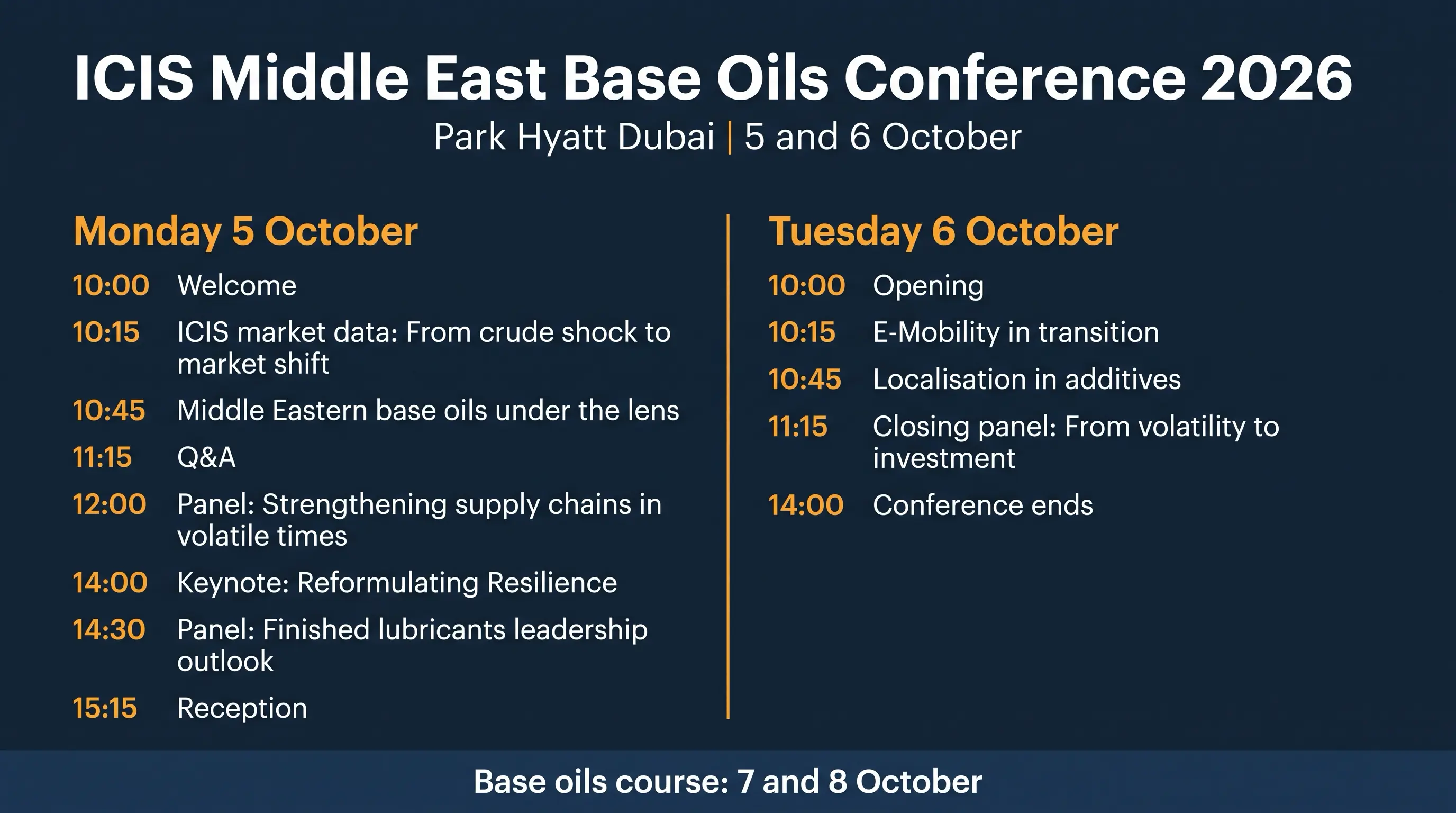
Monday 5 October. ICIS presents its own market data, including a session on Middle Eastern base oils. The noon panel on supply chain resilience brings together Bahri Chemicals, Luberef, and Shell Lubricants Egypt. The afternoon includes an ENOC keynote on lubricant technology for a multi-fuel future and a finished lubricants panel with United Grease & Lubricants, Castrol META, and General Petroleum.
Tuesday 6 October. Kline & Company on e-mobility, Lubrizol Additives on additive localisation, and a closing panel on investment with Luberef, Emarat, and Globestar Energy. The conference ends at 14:00.
7 and 8 October. The base oils course covers API groups in practice, manufacturing, pricing and forecasting, a profitability comparison of Group I, II, and III plants, and re-refined, bio-based, and synthetic oils. It is priced separately.

When and where is the ICIS Middle East base oils conference 2026?
At Park Hyatt Dubai, on Dubai Creek, on 5 and 6 October 2026. The base oils course is on 7 and 8 October at the same hotel.
Is it a four-day conference?
No. The conference runs 5 and 6 October. The next two days are a separate training course with its own fee.
Who organises it?
ICIS. Session times, speakers, and ticket prices are on the official ICIS event page.
What is the difference between Group II and Group III base oils?
Both are hydroprocessed with low sulfur and high saturates. Group III goes through more severe processing and has a higher viscosity index, above 120.
Why does additive localisation matter?
It reduces the risk that freight or trade policy changes stop a blending run by keeping additive supply closer to the blender.
The SynergySol Trading desk supplies distributors, blenders, and fleet operators across Africa, the Middle East, and Europe. Request a quote with a COA for Group I, II, or III. Explore our base oil products, read our guide to Group III base oils.