
SN Base Oil Grades: SN150, SN350, SN500, SN600 Explained

Choosing the wrong SN grade can leave a hydraulic fluid too thin under load, or a gearbox with too little film protection. SN stands for solvent neutral, which means Group I, solvent-refined base oil. The number is an old Saybolt viscosity band, not a quality score. The common SN grades are SN150, SN350, SN500 and SN600. Bright stock is often quoted alongside them, but it is not the next SN number. It is a residual, deasphalted oil and much heavier. The viscosity figures below are typical ranges. For your own lot, the COA is the document that counts.
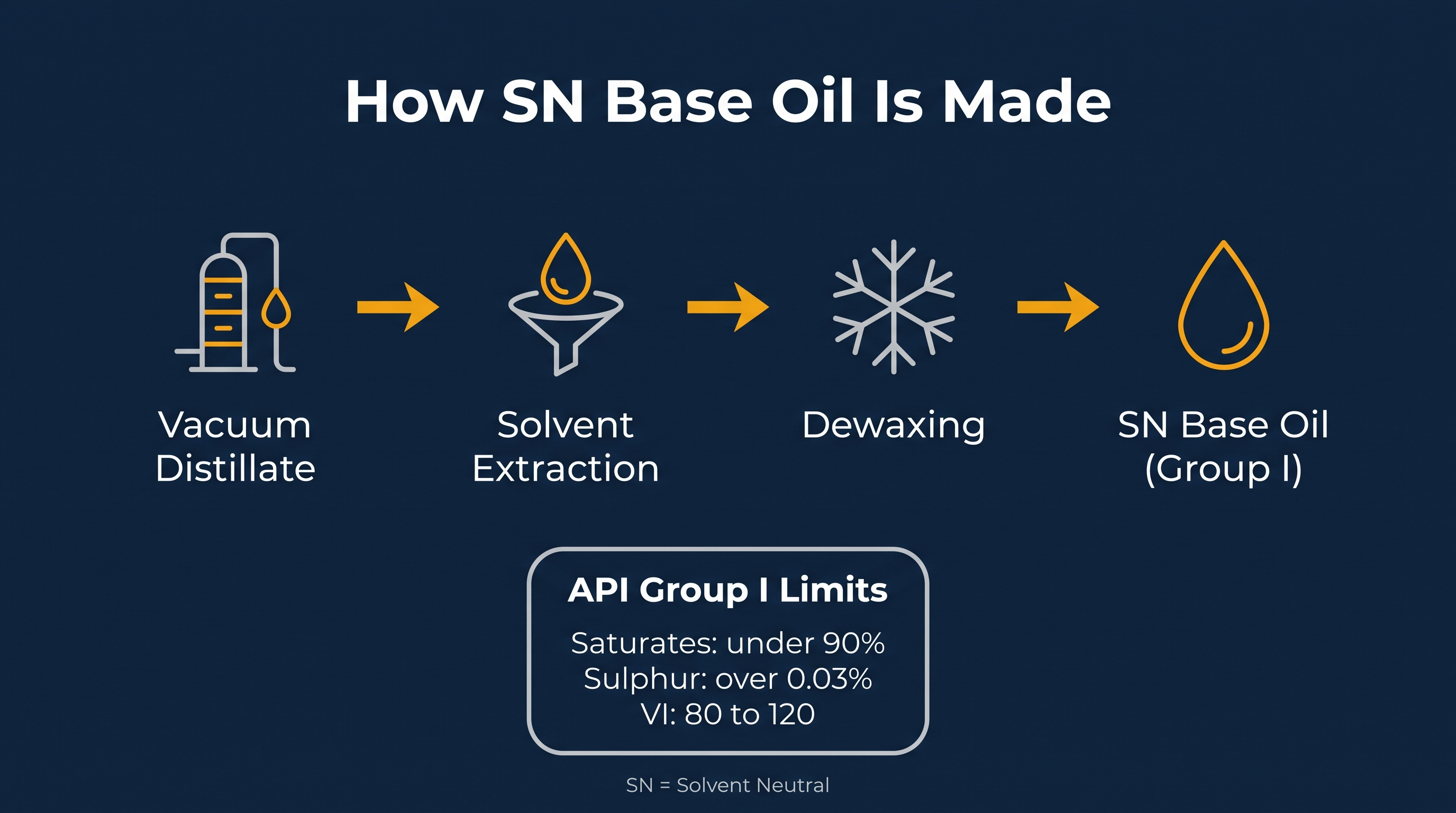
Solvent neutral is a process name. The distillate is solvent-extracted and then dewaxed. The result has less than 90 percent saturates and/or more than 0.03 percent sulphur, with a viscosity index (VI) usually between 80 and 120. That places it in API Group I. A hydroprocessed base oil can have a similar viscosity and still be Group II, so do not rely on the SN label alone. Check saturates, sulphur and VI.
The numbers 150, 350, 500 and 600 refer to Saybolt Universal Seconds at 100°F, rounded. They line up roughly with kinematic viscosity at 100°C of about 5, 8, 11 and 13 cSt. Infineum still uses this shorthand, describing SN150 as the light Group I grade at around 5 cSt at 100°C.
For buying advice on the lightest cut, including documents and packing, see our guide to sourcing SN150. This page covers the full slate.
The figures below are typical ranges, not a SynergySol COA, and individual lots vary. Kinematic viscosity (KV) is measured by ASTM D445 and VI by ASTM D2270. Fleets in hot climates such as the Gulf and East Africa notice a weak VI first. See our article on summer heat and viscosity for more.
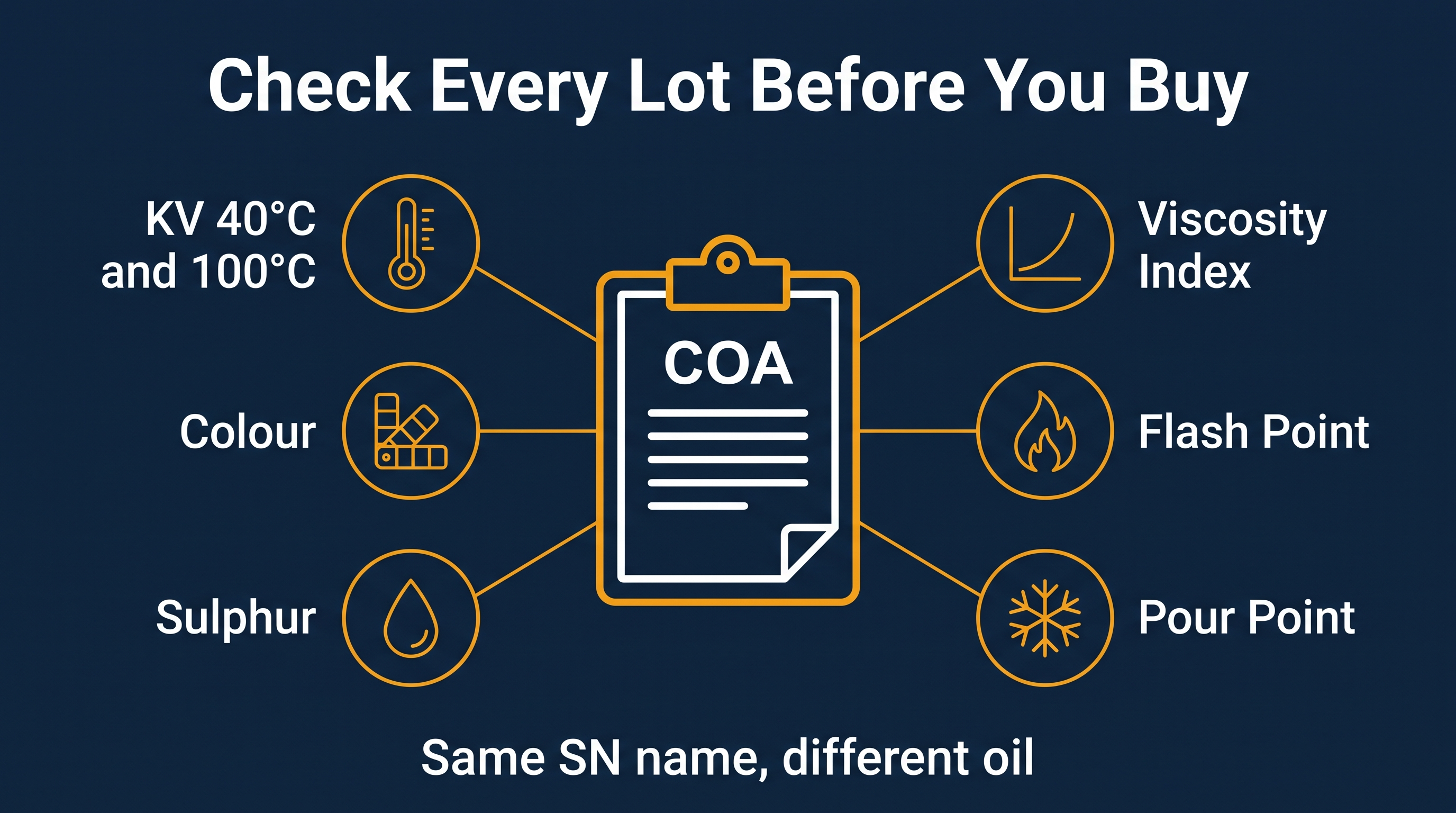
Flash point rises with each heavier cut. SN150 typically sits around 200°C (COC), SN500 and SN600 run higher, and bright stock can exceed 300°C. Pour point matters most for winter handling and storage. Two drums with the same SN name but different pour points are effectively different products, especially in a Middle East and Africa warehouse in January.
SN150 is the thinnest solvent-neutral grade. It has low viscosity and pumps easily, but it forms a thinner lubricating film. It suits formulations that need good flow, such as ISO VG 32 and 46 hydraulic oils, light spindle oils and some process oils. It is not a substitute for heavier grades in a gear oil, however attractive the price is that week.
SN350 is the least common of the four. Some refineries produce it and others skip it, selling only SN150 and SN500. If a quote lists SN350, ask for the KV at 40°C and 100°C regardless. One refinery's mid cut can be close to another's light SN500.
SN150 should be pale in colour. A dark SN150 usually points to fuel dilution, oxidation or a heavier oil sold under the wrong label. Reject that lot rather than negotiate a discount.
When blenders ask for "Group I heavy", they usually mean SN500. Its KV at 100°C is around 11 cSt, and it is used in engine oils, industrial gear oils and metalworking fluids. It is generally easier to source than bright stock. As with any base oil purchase, consistent quality from lot to lot is worth more than a slightly lower price.
SN600 is one step thicker, with KV at 100°C often between 12 and 13.5 cSt. Grease makers and producers of heavier industrial oils choose it when SN500 leaves the finished viscosity too low. It is still a distillate, so it cannot replace bright stock in a marine cylinder oil or in a high-soap grease that depends on residual solvency.
Switching between SN500 and SN600 changes film strength, flash point and often pour point, so re-run your blend sheet. Adding a little more SN500 does not make it SN600 unless the COA falls within the SN600 range.
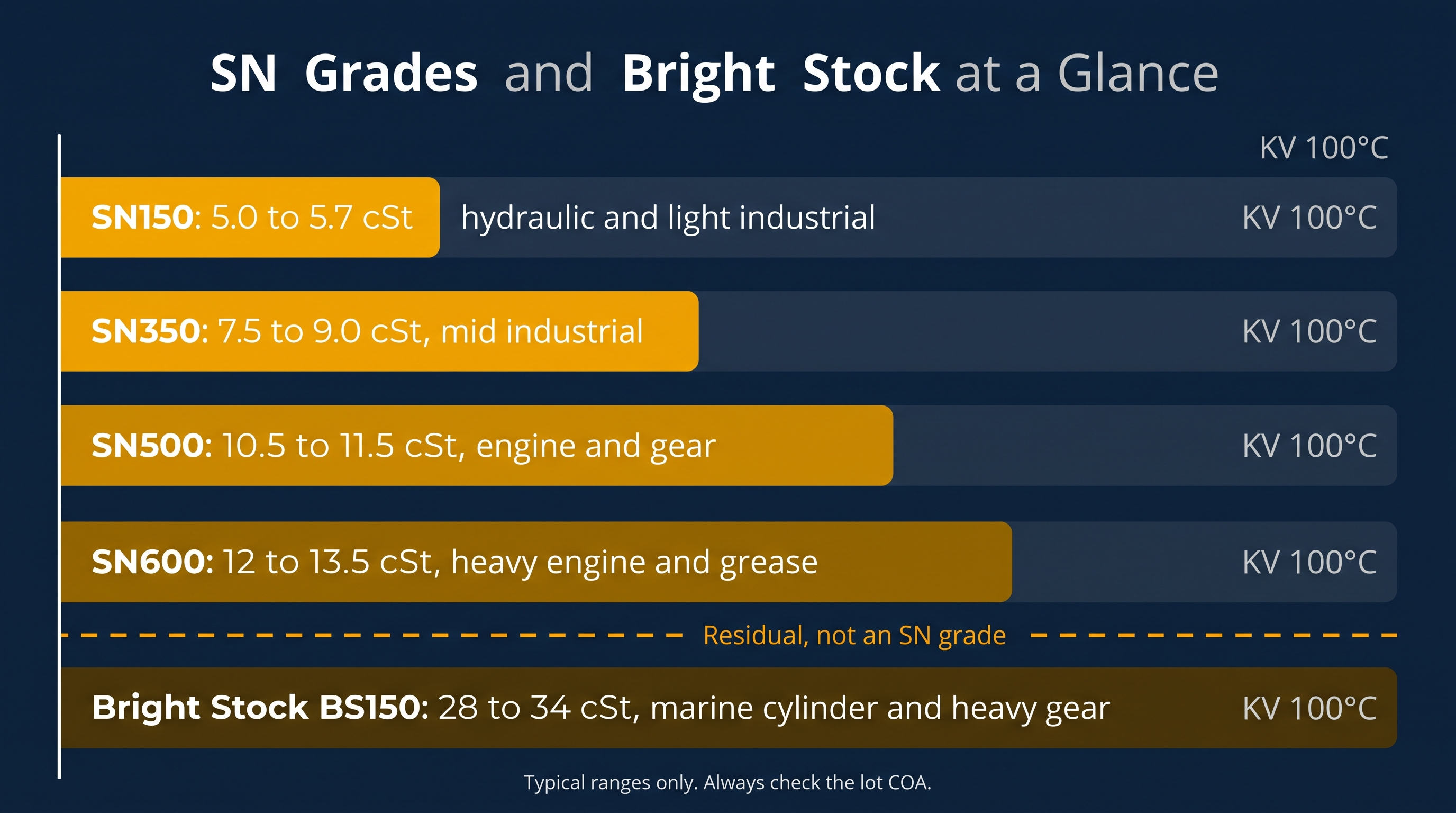
Bright stock, usually sold as BS150, comes from the vacuum residue, followed by propane deasphalting and finishing. Its KV at 100°C is around 30 cSt, which is why it thickens marine cylinder oils and is needed in grease soaps. SN600 cannot do this job by viscosity alone, because the value of bright stock lies in its solvency and its residual fraction.
Supply of bright stock is structurally tight because Group I refineries keep closing. We cover that in our article on bright stock market trends. For this page, the point is the definition: bright stock is residual and heavy, and it is not an SN grade.
To choose the right base oil for a formulation, start with our base oil selection guide, then check each lot against KV at 40°C and 100°C, VI, flash point, pour point, sulphur and colour. Packing and Incoterms work the same way as for SN150. Options include drums, flexibags, ISO tanks and bulk shipments, priced FOB, CFR or CIF to a named port.
What does SN mean in SN150?
SN stands for solvent neutral, a Group I base oil made by solvent refining. The number is an old Saybolt viscosity band, not a quality grade.
What is the difference between SN150 and SN500?
Viscosity. SN150 is a light distillate at about 5 cSt at 100°C, and SN500 is a heavy neutral at about 11 cSt. Both are Group I, but they give different film strength.
Is SN600 the same as bright stock?
No. SN600 is a distillate, while bright stock is a residual oil at about 30 cSt at 100°C. Their solvency is also different.
What is SN350 used for?
It is used in mid-weight industrial oils when SN150 is too thin and SN500 is too heavy. Not every refinery produces it, so confirm the KV on the lot.
Are SN grades always Group I?
The SN name follows a Group I convention. A hydroprocessed oil can have a similar viscosity and still be Group II, so check saturates, sulphur and VI.
Can I substitute SN500 for SN600?
Only if the finished KV and flash point still meet your spec. A straight swap changes film strength, so reblend or request a new COA.
SynergySol Trading supplies Group I, II and III base oils to blenders in the Middle East, Africa and Europe. That includes the SN range and bright stock when a lot is available. Every quote states the grade, the lot COA, the packing and the Incoterm. We do not sell on the grade name alone.
Contact SynergySol Trading to ask about current availability, a sample COA and lead times.